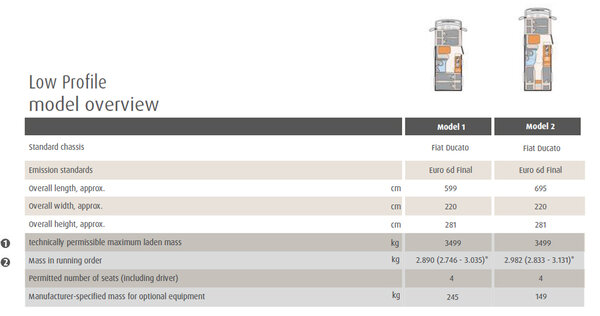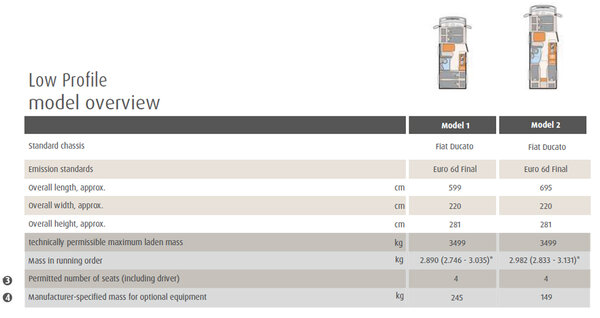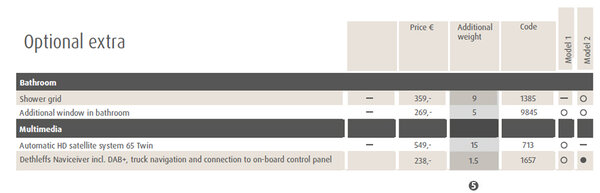
- Length
- 668 cm
- Width
- 219 cm
- Height
- 266 cm
- Sleeping berths max.
- 3
- Price


Living in the GLOBEBUS GO ACTIVE
-

Invitingly modern
The interior design of the GLOBEBUS GO combines matt white, handleless overhead locker doors with natural wood tones and contrasting surfaces in anthracite. The result is a living space that conveys cosiness and style.
The special HERON upholstery for the ACTIVE edition enhances the interior with its refined surface texture. -
Customisable lighting mood
The “Light Moments” lighting system in the ACTIVE models creates an ultra-cosy atmosphere via a mix of direct and indirect light sources.
-
Light and fresh air inside the vehicle
The 70 x 50 cm panoramic skylight fills the interior with natural light and ensures good airflow.


-
Sleep like at home
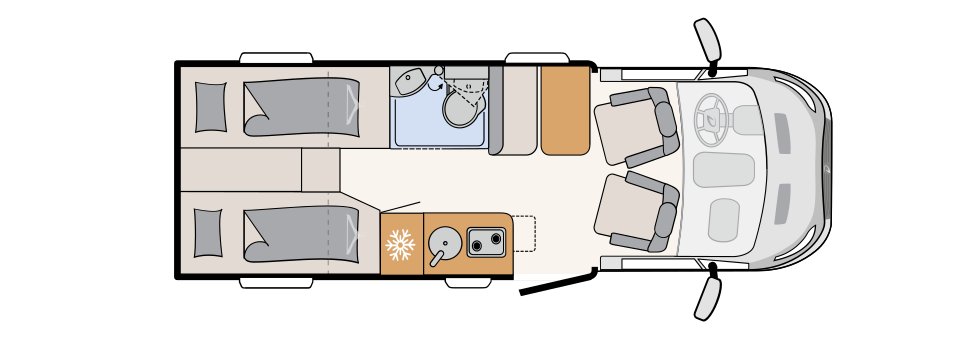
Optionally, the comfortable and generously sized (201 x 80 and 193 x 75 cm) single beds can be converted into a large sleeping area in a few easy steps, which extends across the entire width of the vehicle.
-
Plenty of storage in the bedroom
There’s no shortage of storage space in the bedroom – with overhead lockers, open shelves, a step compartment, and large cupboards on either side beneath the beds.
Both cupboards include a clothes rail, so shirts, blouses and jackets can be hung up to keep them crease-free. They are also spacious enough to store boxes, baskets, shoes and everything else you’ll want to take with you on your travels. -
USB charging port in the bedroom
Handy touch: phones and other devices can be charged directly in the bedroom via a dual USB charging port.


-
Smart swivel wall solution
Despite its compact dimensions, the bathroom in the GLOBEBUS GO ACTIVE is surprisingly roomy – thanks to its clever swivel wall. It comes fully equipped with a sink, toilet, shower and a generous amount of storage space.
-
Smart swivel wall solution – Part I
The bathroom in the basic position! The swivel wall nestles against the outer wall to save space, creating plenty of elbow room.
-
Smart swivel wall solution – Part II
To transform the bathroom into a shower cubicle, simply release the lock and swing the swivel wall out over the toilet.
-
Smart swivel wall solution – Part III
The shower cubicle! In combination with the plastic-panelled sliding door, the result is a fully waterproof shower cubicle. We can’t imagine a better use of limited space.
-
Large mirror
… a practical and popular feature!


-
Compact kitchen
Compact yet packed with every refinement – the kitchen in the GLOBEBUS GO ACTIVE has everything you need to satisfy your appetite.
-
Compressor fridge
A 131-litre compressor fridge/freezer combination is fitted as standard in the ACTIVE model.
This technology offers several advantages: it cools down much faster than a gas-operated absorption fridge and maintains its temperature even in extreme heat or when the vehicle isn’t perfectly level.
The compressor fridge reaches its full potential when paired with a lithium-ion battery and/or solar panels. -
Easy-access storage
The drawers feature high-quality, sturdy pull-outs and offer plenty of convenient storage space.
-
Extra worktop space
The fold-out worktop extension provides an additional work surface whenever you need it.


Dimensions

T 45
2,0 l TDCi Ford EcoBlue
Fuel Diesel
6-gear
- CCM
- Power
Weight
- Mass in running order
- 2.650 kg
- Towable load braked
- 2.000 kg
- Towable load unbraked
- 750 kg
| Electrical installation |
|---|
| Standard equipment |
| Awning light 12 V |
| EBL with separate FI protection switch |
| Number of sockets 1x 12V, 7x 230V, 4x USB |
| LED lighting throughout the vehicle |
| Automatic switch-on/disconnect for starter battery, leisure battery and refrigerator |
| On-board control panel |
| Spotlights in the roof lining above the habitation door |
| Leisure battery AGM, 95 Ah |
| Light Moments: Indirect wall surface ambient lighting |
| Light Moments: Indirect ambient lighting above the overhead lockers |
| Optional equipment |
| 2nd AGM habitation battery, 95 Ah incl. 45 A charge booster |
| 2nd habitation battery (lithium), 168 Ah incl. 45 A charge booster |
| Solar power system 110 watt |
| Heating |
|---|
| Standard equipment |
| Diesel hot air heating 6 kW with hot water boiler and integrated height kit |
| Heating in the seating unit for optimum heat distribution, built-in |
| Optional equipment |
| Diesel hot air heating 6 kW with 1.8 kW electric heating element incl. digital control element and integrated height kit |
| Digital control element for hot air heating |
| Water supply |
|---|
| Standard equipment |
| Fresh water tank in insulated and heated area |
| Submersible pump |
| Optional equipment |
| Switch for water pump |
| Insulated waste water tank |
| Gas supply |
|---|
| Standard equipment |
| Storage space for a gas cylinder with a filling weight of 2.75 kg |

Mattress topper single bed

Universal Storage Shelf

Kitchen Roll Holder
Mattress topper additional cushion up to 500 mm length

SCU/SIU Smart Sensor Temperature

Set of 3 hooks for rail- black

Storage shelf - black

Mount for Gas Indicator Smart Sensor

Storage tray

Retrofittable multifunctional rail

Thermal window screen

Storage tray - silver

SCU/SIU Smart Sensor water tank level indicator

SCU/SIU Smart Sensor Contact

Retrofittable multifunctional rail

Fitted sheet single bed
Fitted sheet additional bottom cushion

Waste water hose set 4 m

Set of 3 hooks for rail - silver

Storage shelf

Paper roll holder

Passenger door safe for Ford Transit

SCU/SIU Smart Sensor tyre pressure

Ford Transit cab carpet for manual transmission

Radiator Grille "Raptor"

cover panel for sinks

SIU base unit incl. leveling and voltage